Article: Lab Grown Diamonds vs Natural Diamonds: The Complete Honest Guide
Lab Grown Diamonds vs Natural Diamonds: The Complete Honest Guide
Lab Grown Diamonds vs Natural Diamonds: The Complete Honest Guide
 Diamond Education 15 minute read · By Peter Sakaris, Sakaris Jewelers Naples Florida
There is one question that comes up in almost every engagement ring consultation we have, and it comes up early. Should we get a natural diamond or a lab grown diamond? It is a smart question. And it deserves a genuinely honest answer, not a rehearsed pitch, not an inventory-driven recommendation, and not a vague "it depends" that leaves you more confused than when you started.
At Sakaris Jewelers, we offer both. We source both. And we have no financial reason to push you toward either one. What we care about is helping you make the best possible decision for your specific situation, your values, your goals, and your life.
This guide is the most complete and honest resource we know how to write on the subject. By the time you finish reading it, you will understand exactly what the differences are, what they mean for you, and how to make a decision you feel completely confident about.
What Is a Natural Diamond?
A natural diamond is a diamond that formed beneath the surface of the Earth, typically between 100 and 200 miles underground, over the course of one to three billion years. The conditions required to create a diamond naturally are extreme: temperatures approaching 2,200 degrees Fahrenheit and pressures roughly 725,000 pounds per square inch. Over geological timescales, carbon atoms arrange themselves into the crystal lattice structure we recognize as a diamond.
These stones are then transported closer to the Earth's surface through volcanic activity in formations called kimberlite pipes. Miners access them through open pit or underground mining operations, after which the rough diamonds are cut, polished, and eventually certified and sold.
The word that defines a natural diamond above all others is rarity. No two natural diamonds are identical. Each one carries the specific fingerprint of the geological conditions under which it formed. Inclusions, color gradients, and growth patterns are unique to each stone. This is not a flaw. It is the story of something genuinely ancient and irreplaceable.

What Is a Lab Grown Diamond?
A lab grown diamond is a diamond created in a controlled laboratory environment using one of two primary methods: High Pressure High Temperature (HPHT) or Chemical Vapor Deposition (CVD). Both methods replicate the conditions under which natural diamonds form. The result is a diamond with the same chemical composition, the same crystal structure, and the same physical and optical properties as a natural diamond.
Lab grown diamonds are not diamond simulants. They are not cubic zirconia. They are not moissanite. They are not synthetic in the way that word is commonly understood. They are real diamonds, grown from a carbon seed, composed entirely of carbon atoms arranged in the same crystalline structure as any diamond pulled from the Earth.
The process is remarkable. What takes nature billions of years, a laboratory can replicate in a matter of weeks.
"There is genuinely no physical difference between the two. They are both real diamonds made of carbon. One is formed naturally over billions of years within the Earth, while the other is created in a controlled laboratory environment using advanced technology that replicates the same conditions. Both are beautiful options. My job is not to push clients toward one or the other. My job is to educate them honestly and help them make the best possible decision for themselves."
Peter Sakaris — Founder, Sakaris Jewelers
Are Lab Grown Diamonds Real Diamonds?
Yes. Categorically and without qualification.
A lab grown diamond is a real diamond by every scientific, gemological, and physical measure that exists. The Gemological Institute of America, which is the global authority on diamond grading, certifies lab grown diamonds. The Federal Trade Commission updated its guidelines in 2018 to recognize lab grown diamonds as diamonds, removing the word “synthetic” from its recommended terminology.
The only thing a lab grown diamond is not is mined. That is a distinction of origin, not a distinction of quality or authenticity.
Quick answer: Are lab grown diamonds real diamonds? Yes. Lab grown diamonds are chemically, physically, and optically identical to natural diamonds. Both are composed of pure carbon in a crystalline structure. They are graded on the same 4 Cs, certified by the same laboratories, and indistinguishable to the naked eye.
Can You Tell the Difference Between a Lab Grown and Natural Diamond?
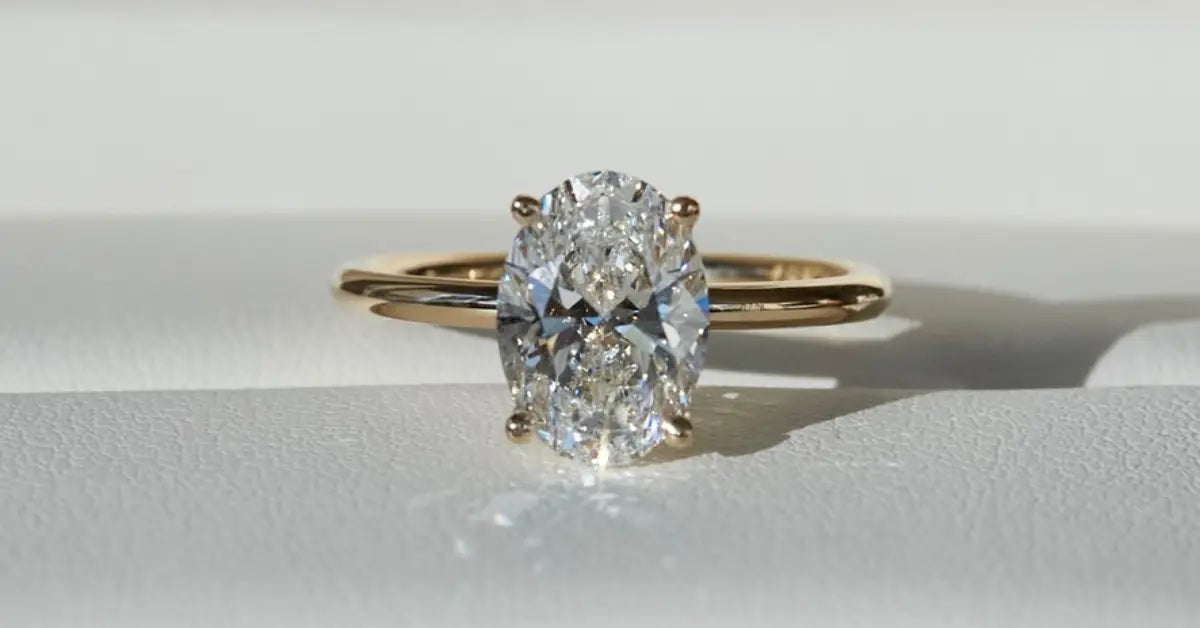
With the naked eye: no. Not under normal circumstances. Not in a ring. Not on a hand. Not across a dinner table. Not even side by side.
A trained gemologist using specialized equipment can identify a lab grown diamond based on specific growth patterns and trace element composition. But this requires tools that no one carries in daily life, and the visual result, the sparkle, the brilliance, the fire, is identical.
What this means practically is that no one will ever look at her ring and know the difference. No one at the engagement party. No one at the wedding. No one at the grocery store. The ring will look beautiful because it is beautiful, regardless of where the diamond originated.
The Price Difference: What You Actually Get for Your Budget
This is where lab grown diamonds offer a genuinely compelling advantage, and where honest guidance matters most.
Lab grown diamonds typically cost 60 to 80 percent less than a comparable natural diamond. That is not a small difference. It is the kind of difference that changes the conversation entirely.
Here is what that means in real terms. Imagine a couple with a $15,000 budget for an engagement ring. With that budget and a natural diamond, they might be working with a 1.5 to 2 carat stone of excellent quality. That is a genuinely beautiful ring and a meaningful investment.
With the same budget and a lab grown diamond, they might be working with a 3 to 4 carat stone of equivalent or higher quality. The ring would be extraordinary. And they would still have $8,000 to $10,000 remaining.
That remaining budget could go toward the wedding itself. A honeymoon. A down payment on a home. The beginning of a financial life together. A future upgrade when the timing feels right.
This is not a compromise. This is a different set of priorities, equally valid and equally intelligent. The question is not which diamond is better. The question is what matters most to you, and what you want your investment to represent.

Resale Value and Investment Potential
This is where we owe you the most complete honesty, because this is where the conversation gets more nuanced.
Natural Diamonds and Long-Term Value
Natural diamonds have historically retained value over time better than most other luxury goods. High-quality, well-certified natural diamonds, particularly those graded by GIA in excellent cut, color, and clarity grades, tend to hold a meaningful portion of their purchase price in the resale market. They are finite. They are not being manufactured. Their supply is inherently limited by geology.
This does not mean a natural diamond is a financial investment in the traditional sense. The secondary market for diamonds is not as liquid or transparent as the stock market. Resale values vary based on size, quality, shape, and market conditions. But the long-term value story for natural diamonds is generally more stable.
Lab Grown Diamonds and Resale Value
Lab grown diamonds currently hold less resale value than natural diamonds. This is an honest and important fact to understand before you make a decision. If you purchase a lab grown diamond and later attempt to resell it, you should expect to receive considerably less than the original purchase price.
Our honest guidance: If long-term resale value is a meaningful consideration, a natural diamond is the stronger choice. If you are optimizing for the best possible diamond for your budget today and resale is not a priority, a lab grown diamond is an excellent option. Neither answer is wrong. They simply reflect different priorities.
The 4 Cs: How We Grade Both
Both natural and lab grown diamonds are graded on the same criteria: cut, color, clarity, and carat weight.
Cut — The Most Important Factor
A well-cut diamond reflects light beautifully and appears alive, regardless of whether it is natural or lab grown. We always prioritize excellent cut above all other factors. A poorly cut diamond of excellent color and clarity will still look dull. A beautifully cut diamond of good but not exceptional grades will sparkle constantly.
Color
The grading scale runs from D (colorless) to Z (light yellow or brown). For natural diamonds, we typically recommend G to H color for the best balance of quality and value. For lab grown diamonds, the price difference between color grades is small enough that we often recommend D through F.
Clarity
For natural diamonds, VS1 to VS2 is the sweet spot: genuinely high quality without paying a premium for characteristics invisible to the naked eye. For lab grown diamonds, VVS clarity is often accessible within reasonable budgets.
Carat Weight
Carat refers to the weight of the diamond, not its size. Two diamonds of the same carat weight can look very different depending on their cut and shape. We help every client understand this distinction so they can maximize visual size within their budget.
Certification: GIA vs IGI
The certificate accompanying a diamond is one of the most important documents in the purchase.
For natural diamonds, we exclusively use GIA, the Gemological Institute of America. GIA invented diamond grading and remains the global gold standard. GIA-certified natural diamonds are universally recognized by insurers, appraisers, and buyers worldwide.
For lab grown diamonds, we use IGI, the International Gemological Institute. IGI has become the leading certification body for lab grown diamonds and is widely recognized and respected within the industry.
Both certifications provide a reliable, independent assessment of your diamond. We will always present you with the full certificate for any stone we recommend and walk you through every detail it contains.

Ethical and Environmental Considerations
This topic deserves honest treatment, because it is often oversimplified in both directions.
The Case for Lab Grown
Lab grown diamonds do not require mining. There is no land excavation, no displacement of earth, and no involvement of mining labor practices. For clients who have strong feelings about mining ethics or environmental impact, lab grown diamonds offer a clear alternative.
The Full Picture on Natural Diamonds
The diamond mining industry has changed significantly over the past two decades. The Kimberley Process, established in 2003, was designed to prevent conflict diamonds from entering the mainstream market. Ethical sourcing standards have improved, and many mining operations are major sources of employment and economic development in the communities where they operate.
It is also worth noting that lab grown diamond production, which requires substantial energy to generate the heat and pressure needed to grow diamonds, also carries an environmental impact. The energy source used in production matters significantly. Some facilities use renewable energy; others do not.
The honest answer is that neither option is perfectly clean or perfectly without impact. What matters is your personal values and what you feel comfortable with. Our role is not to tell you what to value. It is to give you the information to decide for yourself.
Durability: Is One Harder Than the Other?
No. Both natural and lab grown diamonds score 10 on the Mohs hardness scale, which is the maximum. Diamond is the hardest natural substance on Earth. A lab grown diamond is just as hard, just as durable, and just as scratch-resistant as a natural diamond. Both will last a lifetime of daily wear without issue.
The Emotional Dimension
This is the part of the conversation that is hardest to quantify but perhaps most important.
For many people, the age of a natural diamond carries genuine weight. Knowing that the stone in their ring formed two billion years ago, in silence and heat, deep beneath the surface of the Earth, before being unearthed and shaped for this specific purpose, carries a meaning that is difficult to articulate but genuinely felt.
For others, this dimension does not resonate in the same way. What matters to them is the relationship the ring represents, the quality of the stone, the beauty of the design, and the freedom to allocate resources wisely without sacrificing beauty.
Both of these responses are legitimate. Neither is more romantic or more practical than the other. They simply reflect different relationships to material objects and what they mean. We have helped clients who felt strongly about natural diamonds. We have helped clients who felt strongly about lab grown. And we have helped many clients who had no prior opinion and simply wanted the best possible outcome for their situation. In every case, the right answer was the one that felt right to them.

Common Myths About Lab Grown and Natural Diamonds
Myth: Lab grown diamonds look fake or cloudy.
Fact: Lab grown diamonds are visually identical to natural diamonds. They have the same refractive index, the same brilliance, the same fire. There is nothing about their appearance that reads as artificial.
Myth: Natural diamonds are a good financial investment.
Fact: Natural diamonds hold their value better than lab grown, but they are not reliable financial investments in the traditional sense. Purchase a diamond because you love it and what it represents, not as a portfolio strategy.
Myth: Lab grown diamonds are not real diamonds.
Fact: They are real diamonds by every scientific, legal, and gemological definition. They are graded and certified by the same laboratories. The FTC recognizes them as diamonds.
Myth: You can tell a lab grown diamond just by looking at it.
Fact: You cannot. Neither can most jewelers without specialized equipment. The visual properties are identical.
Myth: Natural diamonds are always better quality.
Fact: Quality is determined by cut, color, clarity, and carat weight, not by origin. A poorly cut natural diamond will look worse than a well-cut lab grown diamond of the same size, every time.
Myth: Lab grown diamonds will fade or deteriorate over time.
Fact: Lab grown diamonds are just as durable as natural diamonds. They score 10 on the Mohs hardness scale and will not fade, discolor, or degrade with daily wear.
Private Jewelry Design Studio — Naples, Florida
Still not sure which is right for you?
A private consultation with us costs nothing. We will show you actual diamonds in both categories, answer every question you have, and help you make a decision that feels completely right.
Book a Free ConsultationWho Should Choose Each?
Choose a Natural Diamond If…
- ✓ Long-term value retention is important to you
- ✓ The geological age and rarity carries personal meaning
- ✓ You are purchasing a stone that may become a family heirloom
- ✓ You or your partner have a strong emotional connection to naturally formed diamonds
- ✓ Resale value is a meaningful consideration
Choose a Lab Grown Diamond If…
- ✓ Maximizing size and quality within budget is the priority
- ✓ Resale value is not a significant consideration
- ✓ You want to allocate more budget toward your wedding or future together
- ✓ You have strong ethical convictions about mining
- ✓ You want a beautiful, real diamond at a fraction of the cost
Natural vs Lab Grown Diamonds: Side-by-Side Comparison
| Natural Diamond | Lab Grown Diamond | |
|---|---|---|
| Chemical composition | Pure carbon | Pure carbon |
| Crystal structure | Identical | Identical |
| Hardness (Mohs) | 10 | 10 |
| Visually distinguishable | No | No |
| Certification | GIA (above 0.50ct) | IGI |
| Price relative | Higher | 60–80% less |
| Resale value | Stronger | Lower |
| Rarity | Finite, geological | Produced in weeks |
| Durability | Lifetime | Lifetime |
| Best for | Value retention, rarity, legacy | Maximum size and quality per budget |

How Sakaris Jewelers Sources Both
Whether you choose a natural or lab grown diamond, our sourcing process is the same: we hand-select every stone we present to a client.
For natural diamonds, we source GIA-certified stones from trusted dealers worldwide, reviewing each diamond not just for its certificate but for its actual light performance. Two diamonds can share an identical GIA report and look completely different in person. We source the one that looks exceptional, not just the one that qualifies on paper.
For lab grown diamonds, we use IGI-certified stones in the D through F color range and VVS clarity, with excellent cut, polish, and symmetry, and zero fluorescence. The same exacting standard. No compromises.
You will never be asked to commit to a diamond you have not reviewed. For in-person clients in Naples, we show you the loose diamond before anything is set. For remote clients, we share detailed specifications and in many cases video of the actual stone.

Frequently Asked Questions
Are lab grown diamonds real diamonds?
Yes. Lab grown diamonds are chemically, physically, and optically identical to natural diamonds. Both are composed of carbon in a crystalline structure and are graded on the same criteria by the same gemological laboratories. The Federal Trade Commission recognizes them as diamonds.
Can you tell the difference between a lab grown and natural diamond?
Not with the naked eye. Even trained gemologists require specialized equipment to identify the difference. Visually, the two are identical in brilliance, fire, and sparkle.
Do lab grown diamonds hold their value?
Lab grown diamonds currently hold less resale value than natural diamonds. If long-term value retention is important to you, a natural diamond is the stronger choice. If resale is not a consideration, a lab grown diamond offers exceptional quality and size for the budget.
Are lab grown diamonds cheaper?
Yes. Lab grown diamonds typically cost 60 to 80 percent less than comparable natural diamonds, which allows buyers to access significantly larger or higher quality stones within the same budget.
Which diamond is better for an engagement ring?
There is no universal answer. The best diamond is the one that best matches your priorities, your values, and your budget. We help every client make that decision with complete information and zero pressure.
Do lab grown diamonds look fake?
No. Lab grown diamonds are real diamonds and they look exactly like natural diamonds. They have the same brilliance, fire, and sparkle. Nothing about them reads as artificial.
What certification should a lab grown diamond have?
We recommend IGI-certified lab grown diamonds. IGI is the leading certification body for lab grown stones and provides reliable, independent grading recognized throughout the industry.
What certification should a natural diamond have?
For natural diamonds above 0.50 carats, we recommend GIA certification. GIA is the global standard for natural diamond grading and the most trusted name in the industry.
Does Sakaris Jewelers offer both natural and lab grown diamonds?
Yes. We source and offer both, presenting both options honestly with no inventory bias in either direction. Our only goal is helping you make the right decision for you.
How do I know which one is right for me?
Start with your budget, your values, and what you want the diamond to represent. If rarity and long-term value matter, lean natural. If maximizing quality and size within budget matters, lab grown is an excellent choice. A private consultation with us will help you see both options side by side and make the decision with complete confidence.
The Bottom Line
Lab grown diamonds and natural diamonds are both real diamonds. Both are beautiful. Both will last a lifetime. The differences are in origin, price, and resale profile, and those differences matter differently to different people.
The right diamond is the one that feels right for your relationship, your values, and your life together. There is no wrong answer when you make the decision with complete information and no pressure.
That is exactly what we are here for.
Sakaris Jewelers — Naples, Florida — Private Jewelry Design Studio
Begin Your Custom Engagement Ring
Meet us in person at our private Naples studio or connect virtually from anywhere in the United States. Bring questions. Bring inspiration images. Come with nothing at all. Either way, we will take it from here.
Schedule Your Free ConsultationRelated reading: The Complete Diamond Education Guide · Custom Engagement Rings Naples FL · Areas We Serve